
When the Multi-Car Discount Doesn't Apply
You bought a second car, added it to your existing policy, and expected the multi-car discount to lower your combined premium. Instead, your bill went up by the full cost of insuring the new vehicle—no discount appeared. Or the discount applied to one car but not the other, and your carrier's explanation didn't match what you read online.
The multi-car discount exists at every major carrier, but the rules that determine eligibility vary significantly. Some carriers require every vehicle to be garaged at the same address. Others allow vehicles at different addresses as long as all drivers live in the same household. A few carriers apply the discount only when you add vehicles during the same policy term, not mid-term. Missing one carrier-specific requirement blocks the discount entirely, and most drivers don't learn the rule until after the policy is already written.
Compare car insurance rates in your state
Get quotes from licensed carriers — no obligation, no spam, results in minutes.
Get Your Free QuoteNational Carrier Roster
34 carriers
The national carrier roster includes 34 major auto insurers writing multi-vehicle policies. Each applies multi-car discount rules differently, and switching carriers mid-year to capture a better discount structure often requires re-rating every vehicle on the new policy.
NAIC carrier licensing data, 2023
What Defines a Multi-Car Policy
A multi-car policy insures two or more vehicles under one policy number, typically with one named insured and one renewal date. The multi-car discount applies to the policy, not to individual vehicles—carriers reduce the total premium when multiple cars sit on the same policy, but the discount percentage and the base rate it applies to vary by carrier.
The structural confusion arises because carriers use different definitions of what qualifies vehicles for the same policy. State Farm and Allstate typically require all vehicles to be garaged at the same address and owned by members of the same household. Progressive and Geico allow vehicles garaged at different addresses as long as the drivers are related or share a household. USAA extends multi-car eligibility to military families with vehicles garaged at separate duty stations, provided all drivers are listed on one policy.
When you add a vehicle mid-term, most carriers re-rate the entire policy rather than simply adding the new car's premium. The multi-car discount recalculates based on the new vehicle count, but if the newly-added car doesn't meet the carrier's specific eligibility rules—wrong garaging address, titled to someone outside the household, added after the policy's initial term—the discount may not apply to that vehicle, and in some cases the carrier removes the discount from the existing vehicles as well.
The multi-car discount requires every vehicle to meet the carrier's household, garaging, and policy-term rules. Missing one requirement can block the discount on all vehicles, not just the newly-added car.
Carrier-Specific Discount Structures
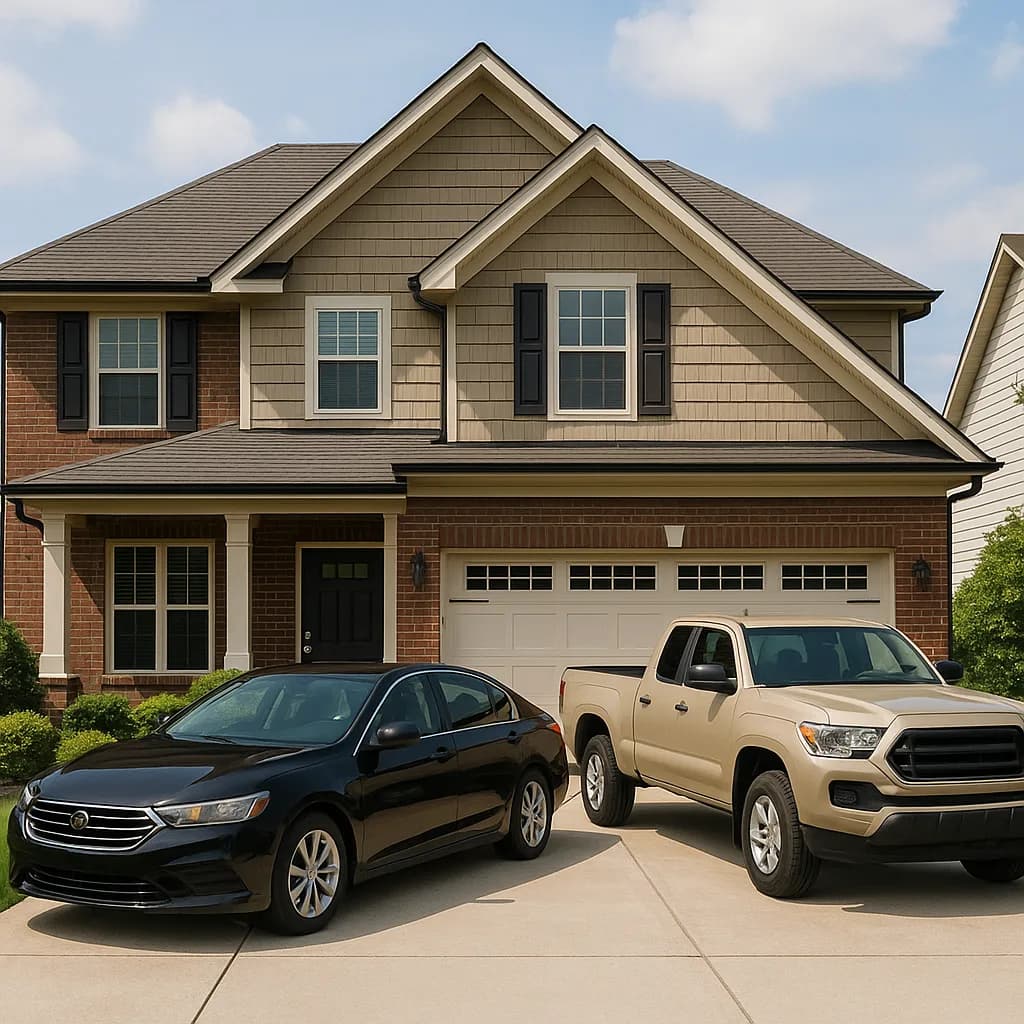
State Farm and Allstate apply the strictest household and garaging rules. Every vehicle must be owned by a member of the same household, garaged at the same address listed on the policy, and added during the same policy term. If you buy a second home and garage a car there, that vehicle typically requires a separate policy—it won't qualify for the multi-car discount on your primary-residence policy even if you own both properties. Farmers and Nationwide follow similar structures but allow limited exceptions for college-student vehicles garaged at a campus address, provided the student remains a listed driver on the family policy.
Progressive, Geico, and Liberty Mutual use more flexible household definitions. Vehicles garaged at different addresses qualify for the multi-car discount as long as all drivers are related or share a household, and the policy lists every driver and every vehicle. A married couple with one car garaged at a primary home and another at a vacation property can often combine both vehicles on one Progressive policy and receive the multi-car discount. Geico extends this to roommates in some states, allowing unrelated drivers sharing a residence to combine vehicles on one policy, though the discount percentage is often smaller than for family households.
Related Articles






Mid-Term Additions and Discount Recalculation
When you add a vehicle mid-term, the carrier re-rates the entire policy from the addition date forward. The multi-car discount recalculates based on the new vehicle count, but the discount doesn't always increase proportionally. A two-car policy receives a certain discount percentage; adding a third car may increase the discount, but if the third car is a high-value vehicle or driven by a young driver, the base premium increase can outweigh the discount gain.
Some carriers apply the multi-car discount only to vehicles added during the initial policy term. If you start a policy with one car and add a second car three months later, the second car may not qualify for the discount until the next renewal. Travelers and Hartford follow this rule in several states—the discount applies at renewal when all vehicles have been on the policy for a full term, but mid-term additions are rated individually until that renewal date.
The failure mode most drivers miss: adding a vehicle titled to a household member who isn't listed on the policy. If your spouse buys a car and titles it in their name alone, and they aren't a named insured or listed driver on your policy, that vehicle won't qualify for your multi-car discount even if it's garaged at the same address. The carrier treats it as a separate risk. You'll need to add your spouse as a listed driver, re-rate the policy to include their driving record, and then add the vehicle—only then does the multi-car discount apply.
State Minimum Liability Range
$15,000–$50,000
State minimum liability limits for bodily injury per person range from $15,000 to $50,000 across the U.S., with most states requiring $25,000. Multi-car policies must meet the state minimum for every vehicle, and carriers often require higher limits when insuring three or more cars to reduce their own risk exposure.
State insurance department regulations, 2023
Combining Policies After Marriage or Moving In
When two people with separate policies get married or move in together, combining policies usually lowers the total premium—but not always. Each person's driving record, vehicle type, and current carrier affect whether the combined rate beats keeping two separate policies. If one person has a clean record and the other has a recent at-fault accident, the clean-record driver's premium will increase when the accident is factored into the combined policy rating.
The multi-car discount applies to the combined policy, but the base rate recalculates using both drivers' records and both vehicles' profiles. A 30-year-old with a clean record driving a sedan and a 25-year-old with a speeding ticket driving a sports car will see a combined premium higher than the 30-year-old's solo rate, even with the multi-car discount applied. The discount reduces the combined total, but it doesn't eliminate the risk-based rate increase from adding the higher-risk driver.
Carriers handle this differently. State Farm and Allstate typically assign each vehicle to a primary driver and rate that vehicle based on that driver's record, then apply the multi-car discount to the total. Progressive and Geico rate the policy based on the household's overall risk profile, assigning the highest-risk driver to the highest-risk vehicle and applying the discount after. If you're combining policies, request quotes from multiple carriers—one carrier's rating structure may produce a significantly lower combined premium than another's, even with the same multi-car discount percentage.
Compare Carriers That Write Your Household Structure
The multi-car discount percentage matters less than the total premium after the discount is applied. A carrier advertising a larger discount may still produce a higher total cost if their base rate is higher. A smaller discount on a lower base rate often beats a larger discount on a higher one.
Start by identifying carriers that write policies for your specific household structure. If you have vehicles garaged at two addresses, focus on Progressive, Geico, and Liberty Mutual. If all vehicles are garaged at one address and owned by immediate family, State Farm, Allstate, and Farmers typically offer competitive multi-car rates. If you're combining policies after marriage and one driver has a violation, compare carriers that rate each vehicle individually rather than blending the household risk—this structure often produces a lower combined premium when driving records differ significantly.